
SEO Best Practices for Next-Gen Web Applications
pchejara
Digital Specialist · Hiya Technologies
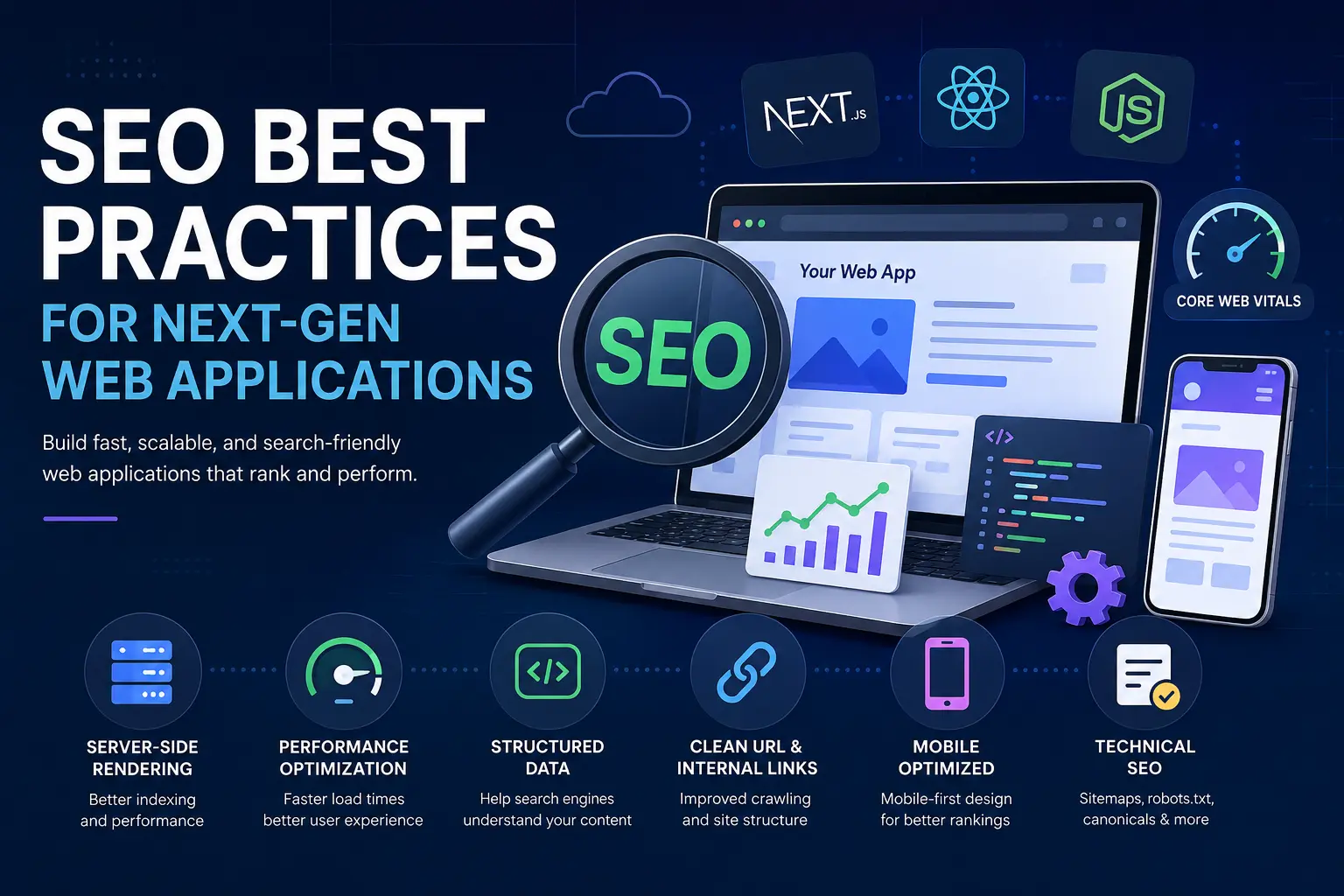
SEO Best Practices for Next-Gen Web Applications
Modern web applications are becoming faster, more interactive, and increasingly dependent on technologies such as JavaScript frameworks, APIs, cloud infrastructure, Progressive Web Apps (PWAs), and artificial intelligence. While these technologies create powerful user experiences, they can also introduce new challenges for search engine optimization.
A visually impressive web application is not automatically search-engine friendly.
For businesses building modern websites and applications, SEO must be considered from the beginning of development—not added after the application is complete. A strong SEO strategy helps search engines discover, understand, index, and rank your content while ensuring users receive a fast and seamless experience.
This guide explores the most important SEO best practices for next-generation web applications.
1. Build SEO into the Application Architecture
One of the biggest mistakes in modern web development is treating SEO as a final checklist.
SEO should influence architectural decisions from the beginning of a project.
Developers and businesses should consider:
- How pages will be rendered
- How search engines will access content
- How URLs will be structured
- How metadata will be generated
- How quickly pages will load
- How internal links will be created
- How structured data will be implemented
Applications built using modern technologies such as React, Next.js, Vue, Nuxt, Angular, and similar frameworks may use different rendering approaches. The chosen architecture can directly affect how easily search engines discover and process content.
The goal is simple: important content should be accessible, understandable, and indexable.
2. Choose the Right Rendering Strategy
Modern JavaScript applications can use several rendering approaches. Choosing the right one can significantly affect SEO, performance, and user experience.
Client-Side Rendering (CSR)
With client-side rendering, the browser loads JavaScript and generates much of the page content dynamically.
This approach can create highly interactive applications, but SEO challenges may occur if important content depends heavily on JavaScript execution.
Potential challenges include:
- Delayed content rendering
- Increased JavaScript processing
- Slower page performance
- Crawling or indexing inconsistencies
- Important content not being immediately available
Server-Side Rendering (SSR)
Server-side rendering generates HTML on the server before sending it to the browser.
This can provide important SEO advantages because users and search engines can receive meaningful content more quickly.
SSR can be particularly useful for:
- E-commerce websites
- News platforms
- Business websites
- Product pages
- Content-heavy applications
Static Site Generation (SSG)
Static Site Generation creates HTML pages in advance, helping websites deliver fast-loading and search-friendly pages.
This approach is suitable for:
- Blog articles
- Documentation
- Company information
- Landing pages
- Product information
Hybrid Rendering
Many next-generation applications use a combination of static generation, server-side rendering, and client-side interactivity.
A hybrid strategy can provide an effective balance between SEO, performance, scalability, and user experience.
The key principle is that important SEO content should not depend entirely on delayed client-side JavaScript.
3. Create Clean and Search-Friendly URLs
URLs are an important part of both SEO and user experience.
A good URL should be simple, descriptive, and easy to understand.
Example of a search-friendly URL:
/blog/seo-best-practices-for-next-gen-web-applications/Less effective example:
/page?id=8472&category=webA strong URL structure should:
- Use meaningful words
- Describe the page content
- Avoid unnecessary parameters
- Maintain a consistent structure
- Use lowercase characters where possible
- Avoid duplicate URL variations
4. Generate Unique Metadata for Every Important Page
Every important page should have relevant and unique metadata.
This includes:
- Page title
- Meta description
- Canonical URL
- Open Graph metadata
- Social sharing metadata
Dynamic applications should generate metadata automatically when pages are created from database content.
For example, an e-commerce platform can dynamically generate optimized titles and descriptions for individual product pages.
Avoid using the same title and description across hundreds of pages.
Unique metadata helps search engines understand the purpose of individual pages and can improve how your pages appear in search results.
5. Implement a Proper Heading Structure
A well-structured page should use headings logically.
- H1 – Main page topic
- H2 – Major sections
- H3 – Supporting topics
Each page should generally have one clear primary topic represented by the main heading.
A logical heading structure improves content readability and helps search engines understand the relationship between topics.
6. Optimize Core Web Vitals and Page Performance
Performance is no longer only a technical concern. It is directly connected to user experience and search visibility.
Modern web applications should focus on improving:
- Loading performance
- Interaction responsiveness
- Visual stability
- JavaScript efficiency
- Image optimization
- Server response times
Common performance optimization techniques include:
- Compressing images
- Using modern image formats
- Lazy-loading non-critical images
- Reducing unused JavaScript
- Code splitting
- Caching static assets
- Using a Content Delivery Network (CDN)
- Optimizing API requests
- Minimizing render-blocking resources
A fast application creates a better experience for users and can reduce the risk of visitors leaving before the page becomes usable.
7. Optimize JavaScript for Search Engines
JavaScript is essential for modern applications, but excessive JavaScript can create performance and indexing challenges.
Developers should avoid sending large JavaScript bundles when they are not necessary.
Consider techniques such as:
- Code splitting
- Dynamic imports
- Tree shaking
- Lazy loading
- Server-side rendering
- Removing unused dependencies
Important content should ideally be available without requiring complex user interaction.
8. Use Structured Data to Help Search Engines Understand Your Content
Structured data provides additional context about a webpage and helps search engines better understand its content.
Depending on the website, relevant schema types may include:
- Organization
- LocalBusiness
- WebSite
- WebPage
- Article
- Product
- FAQPage
- BreadcrumbList
- Service
- Review
For scalable applications, structured data can be generated dynamically based on the page type and available content.
Structured data should always accurately represent the visible content of the page.
9. Build a Strong Internal Linking Structure
Internal links help users and search engines discover related pages throughout your website.
A modern web application should connect relevant content naturally.
Examples include:
- Blog articles linking to related services
- Service pages linking to case studies
- Product pages linking to related products
- Category pages linking to detailed content
- Documentation linking between related topics
Avoid creating orphan pages that have no meaningful internal links.
10. Generate and Maintain XML Sitemaps
Large and dynamic applications should automatically generate and maintain XML sitemaps.
This is particularly useful for:
- E-commerce websites
- Marketplaces
- Blogs
- Listing platforms
- SaaS applications
- Multi-location business websites
When new content is published, the sitemap should be updated automatically.
The sitemap should include canonical and indexable URLs while avoiding broken pages, redirects, duplicate URLs, and pages marked as noindex.
11. Configure Robots.txt Carefully
The robots.txt file helps communicate crawling instructions to search engines.
However, it should be configured carefully.
Do not accidentally block:
- Important JavaScript files
- CSS resources
- Public content pages
- Product pages
- Blog pages
Development and staging environments should also be protected from accidental indexing.
12. Use Canonical Tags to Control Duplicate Content
Modern applications can easily create multiple URLs that display the same or very similar content.
For example:
/products/item
/products/item?source=facebook
/products/item?campaign=spring
Canonical tags help indicate the preferred version of a page.
For dynamically generated applications, canonical URLs should be automatically generated according to the application's routing structure.
13. Make Mobile Experience a Priority
A significant portion of website traffic comes from mobile devices, making mobile optimization essential for modern web applications.
Important considerations include:
- Responsive layouts
- Readable typography
- Easy navigation
- Touch-friendly buttons
- Optimized images
- Fast loading performance
- Minimal intrusive popups
SEO and user experience are closely connected. A technically optimized application that is difficult to use on mobile devices may still struggle to convert visitors into customers.
14. Optimize Images and Media Assets
Images and media are essential for modern websites, but poorly optimized assets can significantly slow down an application.
Best practices include:
- Using modern image formats where appropriate
- Compressing large images
- Serving responsive image sizes
- Using descriptive file names
- Adding meaningful alt text
- Lazy-loading below-the-fold images
- Avoiding unnecessarily large media files
Alt text should naturally describe the purpose and content of an image without unnecessary keyword stuffing.
15. Monitor Technical SEO Continuously
SEO is not a one-time implementation.
Modern applications change frequently. New deployments, framework updates, API changes, and routing modifications can introduce SEO problems.
Regularly monitor:
- Indexing status
- Crawl errors
- Broken links
- Redirect chains
- Page speed
- Core Web Vitals
- Duplicate metadata
- Missing titles
- Missing descriptions
- Sitemap errors
- Structured data issues
SEO monitoring should ideally become part of the development and deployment workflow.
16. Combine SEO with Analytics and User Behaviour
Traffic alone does not define SEO success.
A modern SEO strategy should also analyze what users do after they arrive on the website.
Important metrics include:
- Organic traffic
- User engagement
- Conversion rate
- Form submissions
- Product inquiries
- Page performance
- User journeys
- Exit pages
By combining search data with analytics, businesses can identify opportunities to improve both visibility and conversions.
17. Make SEO Part of the Development Workflow
The most successful next-generation web applications treat SEO as part of engineering and product development.
SEO checks can be integrated into:
- Design reviews
- Development processes
- Pull requests
- Automated testing
- CI/CD pipelines
- Production monitoring
Before deploying a new feature, teams should verify:
- Are the new pages indexable?
- Are metadata fields available?
- Are canonical URLs correct?
- Are internal links working?
- Has page performance changed?
- Is structured data valid?
The Future of SEO Is Technical, Intelligent, and User-Focused
Next-generation web applications are changing how businesses build digital experiences. Technologies such as server-side rendering, edge computing, artificial intelligence, APIs, and modern JavaScript frameworks provide significant opportunities for speed and innovation.
However, technology alone does not guarantee search visibility.
Successful SEO requires a combination of:
- Strong technical architecture
- High-quality content
- Excellent performance
- Clear information structure
- Mobile optimization
- Structured data
- Continuous monitoring
- A user-first approach
Businesses that integrate SEO directly into their web development process will be better positioned to compete as search engines and web technologies continue to evolve.
Final Thoughts
SEO for next-generation web applications is no longer limited to adding keywords and meta descriptions.
It requires collaboration between developers, designers, marketers, and business teams.
From application architecture and rendering strategy to structured data, performance optimization, and analytics, every technical decision can influence how users and search engines experience your website.
Hiya Technology helps businesses build modern, scalable, and SEO-friendly digital solutions designed for performance, usability, and long-term growth.
Whether you are building a corporate website, SaaS platform, e-commerce application, or custom web solution, implementing SEO best practices from the beginning can create a stronger foundation for sustainable organic visibility.
Build for users. Optimize for search. Measure performance. Improve continuously.
Share this article
About the Author
pchejara
A digital specialist at Hiya Technologies with expertise in web development, SEO strategy, and digital marketing. Dedicated to helping businesses build their online authority and scale through technology.
Learn more about usNeed Help With Your Project?
Our team of experts is ready to help you build your next digital product or optimize your online presence.
Get in Touch